Thursday, 21 March 2013

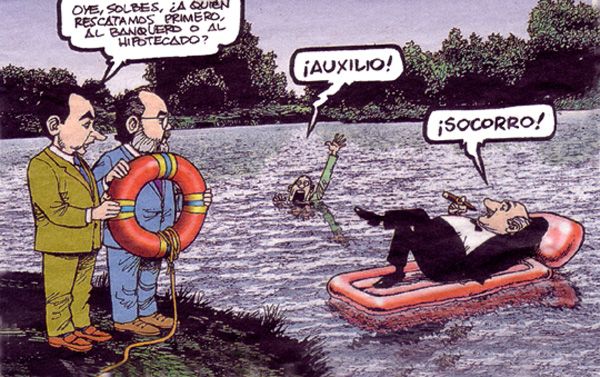
Comic - No Title

 photo Banker210313_zpse7984eaa.jpg
"Help!"
"Help!"
"Solbes, whom shall we save first, the banker or the mortgage holder?"

Tags:banker

Who Is The Clever One Then?

 photo Mar21C_zpsc1961b22.jpg
** The prisoner
Solly is serving time in Wandsworth prison for a securities fraud. Even so, he is still loved by his father Maurice. One day, Maurice writes Solly a letter: -
“My darling Solly,
It looks like I won't be able to plant anything in the garden this year. I am growing too old to do any digging without your help. Looking forward to your early release.
Love from your Dad”
Solly replies: -
“Dearest Dad
Please don't dig up the garden - that's where I hid the money and the securities. Be patient. Wait until I get out.
Love as always Solly”
At 4am in the morning, the police show up at Maurice’s house and dig up the entire garden. Two days later, Maurice receives another letter from Solly: -
“Dearest Dad,
Now the garden has been dug over, you can start to plant your garden. It’s the best I could do from here.
Your devoted son Solly”

** How did you do that?
Moishe the farmer had made out a Will that stipulated how his prize cows would be shared out to his 3 sons on his death. He decided that half the cows should go to his eldest son, one third to his second son and one ninth to his youngest son. He though this was fair.

Some years later he died and his sons knew that there were 17 cows. But they just couldn’t divide them according to their father’s wishes. So they had to call in the learned Rabbi.

After much thought, the Rabbi went away and returned with one of his own cows, making 18 cows. Then the Rabbi gave the oldest son 9 cows, the second son got 6 cows and the youngest 2 cows.
There was still one cow left over, so the Rabbi took his cow back home with him.

Flagrant Dali

 photo Mar21B_zpsa32695f0.jpg
'Flagrant Dali' is the title of a book published in France. It contains stories and anecdotes of the genius from Port Lligat, brought together by his private secretary of many years (1956-1974), Captain John Peter Moore and his wife, Catherine Perrot-Morre. 'Dali a la banque' is one of the short stories. It illustrates the different dimensions of the most famous of all the Emporda's citizens in a moving, and at the same time comic way. Below is an excerpt from 'Flagrant Dali' by Captaine Peter Moore et Catherine Moore (Edition Crasset, Paris)

In the early 1940's, Dali received his first cheque for $5,ooo and decided to cash it. Cala was still asleep, so Dali took the cheque and set off for a branch of his bank on 5th Avenue in New York, where he joined the queue at the counter. When his turn came, he asked to be paid his 5,000 dollars.

"Can I see the cheque?" enquired the bank clerk. Dali took it out from his pocket and showed it to him - from a safe distance.
"Are you going to give me the cheque or not?" the cashier asked him.
"And when are you going to give me the money?" asked Dali mistrustfully.
"If you don't give me the cheque, I can't give you any money." the cashier replied, whereupon Dali snarled at him:
"And what happens if I give you the cheque and you don't pay me the money? What do we do then?"

Dali took the cheque, screwed it into a paper ball, put it in his mouth and started chewing.
The irritated bank employee raised the alarm and, a few seconds later, the security guards arrived on the scene. As they attempted to stop Dali, Cala appeared, who on waking has
realized that not only her husband was missing, but the cheque too. In the end, the Dalis got their money, but the cheque, which Dali had screwed
and chewed, was so damaged that Cala had to call the customer and ask him to issue a new one.

I have never had the slightest inkling of Dali's eccentricity, supposedly common in artists and geniuses, to be boarding on being absurd and, in this case, definitely childish or worse, irrational not to say stupid. Direct contrast to his brilliance in art and creative talent. But this came from his personal secretary, friend and business manager and in print on the official record. I guess it had to be true, but that doesn't make it less ridiculous, genius or not.

Tags:dali,cheque

Mind Your P's & Q's

 photo Mar21A_zps3118d4c6.jpg
Apparently, from words you use to write a story or an article - how many in number, how they are placed, how often you repeat the same words or expressions; the experts of linguistic science can tell whether you suffer, or about to develop, Alzheimer or some kind of dementia. I didn't know that, did you?

Two investigators of the University of Toronto have concluded, after analysing the linguistic of the novels of Agatha Christie, that the famous British authoress had likely suffered Alzheimer.

The study, carried out by Ian Lancashire, professor of the English Department, and by Graeme Hirst, professor of the Informative Science Department, thoroughly analysed 16 novels Christie wrote in the period when she was between 28 and 82 years old, after the digitalisation of her work. The authors counted the numbers of the vocabulary used in the first 50.000 words of each novel. Then they counted the number of different types of phrases. Finally, this is very interesting and rather intriguing, the number of repetitions of infinitives of the verbs. How very curious! The possibility of a connection is way, way above my head!

According to Lancashire and Hirst, the analysis suggested that the repetition of phrases and, in particular, the use of indefinite terms, are 'significant signs of invasive dementia.'. They informed that at present, they are analysing works of other authors who had not been suspected of the disease.

Should I read this little Blog now from the beginning, and start counting ...? On second thought, what's the point if one is predestined to the disease? I might as well concentrate on more pleasurable things while I still can.

The Imperturbable Humour Of Clement Freud

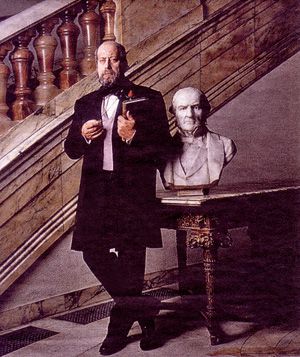
 photo Mar21_zpsb2039862.jpg
Somebody was talking about Isaac Newton and his apple, and I immediately thought of Clement Freud.

To say he was a funny man or comedian is a serious understatement of his capability and achievements. His surname alone represents richness in history and philosophy. But Clement Freud stood out by his own intellectual merits and in diverse professions, as writer, commentator, politician, even chef. True, nobody could ever refrain from repeating that he was the grandson of the founder of psychoanalysis, no more and no less than the forever remembered Sigmund Freud.

He was also brother of the artist Lucian Freud, with whom there existed a strained relationship. Though born in Berlin, he spent most of his life, from 1933, in Britain, with his family running away from the Nazis. Thanks to his very acute, sharp and ingenious humour, often cutting and sometimes black, he became a popular commentator, and host of radio and television programmes. He instill great humour in the public from seemingly total imperturbability, as they say, without moving a muscle.

This ability, to me anyway, is as important as the joke or humour itself. There are people, even some professional comedians, who tell jokes While, or even Before he gets to the punch line by laughing out loud himself, occasionally to such a point that they can hardly continue the joke, with the punch line drown in their own hysterical chuckle. Not Clement. Nearly never laughed, but always and extremely funny. Not just the funny ha ha, but funny thought provoking.

For more than 30 years, he was one of the principal stars of the British BBC Radio programme with comical hints, called 'Just a minute'. At one occasion, he was talking about the great inflation the country was suffering at the time: "A farmer was telling me the other day 'The apples are going up' to which I said "That would surely be a great blow for Isaac Newton.". Intelligent humour; my kind. I wish I hadn't missed out that radio period.

His perspicacious character and his talent for communication led him to be elected for the British Parliament's Liberal Party in 1973, which he carried through for 14 years to 1987. He later became the chef of the famous Hotel Dorchester for the elite, and years later became the proprietor of a nightclub, and writer of food provisioning the political and sports circles.

As writer, he had worked for several mainstream British newspapers, The Observer, The Daily Telegraph, and The Daily Express. In 2002 he was elected as the Principal of the University of St. Andrews, the post he had already developed earlier in 1974, in the University of Dundee.

He passed away in 2009, in his London home, at the age of 84.
 photo ClementFreud_zps8fa98e37.jpg
That's only facts written for the record. I guess he would live forever.

Magic Clerk's Easter Chick

Magician, Comedian, and Actor Michael Carbonaro is the Magic Clerk who amazes some customers when he shows them how the Insta-Chick works. Just add a little water and you’ll have a cute baby chick just in time for Easter. A funny and entertaining clip from The Tonight Show with Jay Leno. I think the two kids that got the free jar of jelly beans and other stuff will always remember that trip to the store.