Thursday, 18 April 2013

Too Littl, Too Late

April 18D photo April18D_zps11c84bd0.jpg
They were the best musicians in the world and they formed, 50 years ago, the best band in the world. Nobody has done better so far. It was the general opinion that they had the biggest and the best success, more than the Beatles, the Rolling Stones, the Beach Boys and Elvis Presley put together. Adding up all the facts and figures, it would show that it's the truth.

They revolutionised the pop music, but they never came out of anonymity and remained with relative poverty. They live a hard life, but in a more or less enjoyable way, under the weight of their trademark: Motown. Only the name Motown was important. They created 4 songs but their names were not even mentioned on the discs.

Anyone remember James Jamerson? He died in 1983 at the age of only 47, of harden tumour, neumonia and pain. He was an extraordinary base player, perhaps the greatest, but had to wait until 1970 when everything seemed to be finishing, to see his name on the cover of the disc. It was on the sleeve of 'What's going on', of Marvin Gaye, a theme the Jamerson brought forth, the notes of which today's professionals still fight for. When this disc was recorded Jamerson was too drunk to sustain himself on his feet and had to lie down on the floor, and playing the instrument above him. He appeared on this disc as: 'the incomparable James Jamerson'. Too little, too late.

There's a book about him in 1989, titled: 'Standing in the shadows of Motown', with a biography, an old interview and some scores with the best lines of base of the great instrumentalist, marking the beginning of recuperation of that group of extraordinary musicians. Three years later, under the same title of 'Standing in the shadow of Motown', a documentary was premiered as homage to the unknown musicians who, between the years of 1959 and 1972, called themselves The Funk Brothers and contributed to not only change the popular music, but breaking the racial barrier in the United States.

The story began in the beginning of 1959, when composer Gordy Jr., in the company of the singer Smokey Robinson, founded in Detroit, Known as Motor Town, later Motown; they needed studio musicians and went around searching the jazz dens to recruit them. In just a few months, and in exchange for a few dollars, the playful musicians, eccentric, outlandish and wild hard drinkers had fabricated their first success of Motown, 'Money (that's all I want)', a theme of the mythical Holland, Dozier & Holland, and later on by the Beatles.

From there on a whole chain of winning hits, without ever occurred to Gordy to pay the musician a little more or, at least, acknowledge their participation in the product. On some discs, the band leader Earl Van Dyke was named, and some anonymous Soul Brothers. In fact they were the Funk Brothers, apart from Van Dyke and Jamerson, there were Joe Hunter, Benny Papa Zita Benjamin, Robert White, Joe Messina, Richard Pistol Allen, Johnny Grifith and other promising students like Stevie Wonder.

In 1970, Motown discovered a family group with a child singer. They were given the name the Jackson Five and lived in Los Angeles. Motown had lost the Hollands, and selling less records. Although still producing great hits, Gordy decided to move to California. The musicians knew about it only when they went to the studio one day and found it closed. A note on the door notified that the company had moved to Los Angeles. The majority of the Funk Brothers decided to stay in Detroit and back to the gambling and jazz joints as always. Others, like Jamerson, followed Gordy and had a hard time with the change. In the case of Jamerson, the loneliness was mortal. Almost overnight, the Funk Brothers disappeared without a trace.

The book of 1989 and the film of 2002 belatedly gave acknowledgement, at last. In 1990, Jamerson was included in the Rock & Roll Hall of Fame. In 2003, George Bush invited the Funk Brothers, the surviving members, to the White House. In 2004, the Funk Brothers received the special Grammy award for their career.

Once again, too little, too late.

How Old Is Grandma?

April 18C photo April18C_zps952e1cf4.jpg
** How old is Grandma? **
Stay with this -- the answer is at the end.? It will blow you away.
One evening a grandson was talking to his grandmother about current events. The grandson asked his grandmother what she thought about the shootings at schools, the computer age, and just things in general.

The Grandma replied, "Well, let me think a minute, I was born before:
' ----------television
'---------- polio shots
'---------- frozen foods
'---------- Xerox
'---------- contact lenses
'---------- Frisbees and
'---------- the pill
There was no:
'---------- Radar
'---------- credit cards
'---------- laser beams or
'---------- ball-point pens
Man had not invented yet:
'---------- pantyhose
'---------- air conditioners
'---------- dishwashers
'---------- clothes dryers
'---------- and the clothes were hung out to dry in the fresh air and
'---------- man hadn't yet walked on the moon

Your Grandfather and I got married first, and then lived together! Every family had a father and a mother! Until I was 25, I called every man older than me, "Sir".
And after I turned 25, I still called policemen and every man with a title, "Sir."
We were before gay-rights, computer- dating, dual careers, day-care centers, and group therapy.

Our lives were governed by the Ten Commandments, good judgment, and common sense! We were taught to know the difference between right and wrong and to stand up and take responsibility for our actions. Serving your country was a privilege; living in this country was a bigger privilege. We thought fast food was what people ate during Lent!
Having a meaningful relationship meant getting along with your cousins!
Draft dodgers were people who closed their front doors when the evening breeze started!
Time-sharing meant time the family spent together in the evenings and weekends-not purchasing condominiums.

What else was there in Grandma's youth?
We never heard of FM radios, tape decks, CDs, electric typewriters, yogurt, or guys wearing earrings!
We listened to the Big Bands, Jack Benny, and the President's speeches on our radios!
And I don't ever remember any kid blowing his brains out listening to Tommy Dorsey!
If you saw anything with 'Made in Japan or China' on it, it was junk!
The term 'making out' referred to how you did on your school exam!
Pizza Hut, McDonald's, and instant coffee were unheard of!

We had 5 &10-cent stores where you could actually buy things for 5 and 10 cents!
Ice-cream cones, phone calls, rides on a streetcar, and a Pepsi were all a nickel!
And if you didn't want to splurge, you could spend your nickel on enough stamps to mail 1 letter and 2 postcards!
You could buy a new Chevy Coupe for $600, . . . but who could afford one?
Too bad, because gas was 11 cents a gallon!

In my day:
'---------- "grass" was mowed,
'---------- "coke" was a cold drink,
'---------- "pot" was something your mother cooked in and
'---------- "rock music" was your grandmother's lullaby.?
'---------- "Aids" were helpers in the Principal's office,?
'---------- "chip" meant a piece of wood,
'---------- "hardware" was found in a hardware store and
'---------- "software" wasn't even a word.

And we were the last generation to actually believe that a lady needed a husband to have a baby. No wonder people call us "old and confused" and say there is a generation gap... and how old do you think I am?

I bet you have this old lady in mind...you are in for a shock! I am - 63 Years young.
 
Tag:Grandma'sAge

The Risk Of Being Intellectual

April 18B photo April18B_zpsf3fc6307.jpg
This morning in my usual cafe, a friend and I were discussing his tentative decision of packing up his home here for the last 18 years and going back to his original home in England. His partner, also a he, died over a year ago, and he found life alone here very depressing. It's a risk, he said, but he must take it, as the alternative of living here with the partner of the past 25 years gone is too painful. During the conversation on the subject, the word "risk" popped up many times, which got me to thinking about it once I got home.

I suppose any important decision, especially the ones that are going to influence or determine your future, and life itself, must carry certain degree of risk, as the outcome is impossible to predetermine, and no definite result could be guaranteed. The decision might lead to positive outcome, and again it might not. Taking a risk also means to commit or implicate oneself to carry out actions that are beyond one's own and exclusive interests, as much an act of risk as compromise.

As an intellectual, he must have turned the idea a hundred times any which way in his mind, as I would have if I were in his situation. In the end, it's just a question of staying put or going back to start afresh. Both carry the same risk of working out well or not at all.

That's the trouble with intellectuals, spending far too much time dwelling on ideas and alternatives which takes weeks, months, or like in my friend's case, almost a year on this one single decision or, rather, indecision. A simpler man, less educated or less of an intellectual, would have done one thing or the other decided in hours or a few days, and the risk he had taken would have been exactly the same as my friend here is facing.

Tags:Intellectual,Risk

Sound The Alarm, Softly

April 18A photo April18A_zps05e2ef7a.jpg
Very rarely but, thankfully, it does happen every once in a while, beautiful orchestra music by dance bands was playing in the cafe when I arrived there, instead of pop or disco variety. The kind that makes you feel like dancing to and, in the case of not possible or practical, swaying to while still sitting at your table, hot coffee in hand, and trying not to spill it all over yourself. Or tap your feet under the table, or hum softly the wordless tunes (I can't whistle you see). It was soothing my recent troubled mind and, after a while, I felt none of my problems was as grave as I had imagined.

The news spread out on the paper on my table though, is counteracting, irritating in fact. Pages and pages of all sorts of alarms, easily grouped into 2 main categories: that of sanitary about Swine Flu, all variety of other flu and infectious diseases; and that of the multimedia information. Too much of both for anybody to take in let alone to benefit from. If you are not confused before about either, now you are, about both.

The alarm of the former, that of the sanitary and, basing on much studied protocol, are or should be operated in the related fields responsible for sanitary issues, as consequences of the extraordinary advances in all aspects of health. It awakes people's knowledge of the disease and learn how to deal with it if one is already sick, and how to prevent it when one is not.

The alarms of the latter, the over abundance of information, sometimes even conflicting, and from all quarters of the media, are quite a different matter. Compare with those of sanitary info, it mostly extends and serves to raise panic, not to avoid it. They forecast what is not yet known, presenting what is a mere foresight as a desperate present situation not yet exist. Many of the healthy and up till now fairly happy people are at the moment worrying themselves sick! What good does this kind of info. do? So that they hope to be able to say one day: "I told you so!" ?
 

The Amusing Steampunk

April 18 photo April18_zps2ac9e2aa.jpg
The term 'steampunk' was coined in 1897, by the writer K. W. Jeter, wanting to find a label that would give sense to the work which didn't situate it's action in the pos-apocalyptic societies, but in the time that never was; that future full of controllable locomotion and submarines that H. G. Wells fantasised about in the 19th century.

In recent years, it has indeed made the jump to real life, and converted into an omnivorous movement that propagate through the Internet, in modus vivendi - a mode of living, at the margin of literature and cinema that feeds on whatever reference of a past in sepia colour: parasols, top hats, crinolines, lace-up corsets, eye shades of aviators ... It's followers have constructed a made-to-measure world, with gallant gentlemen and delicate Victorian ladies. In which the impossible travel stops being so.

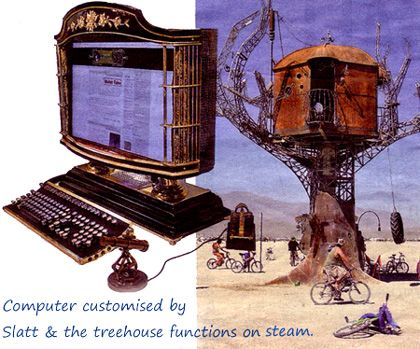
Sean Slattery, a technician of information and communication in Boston, and under the identity of Jack von Slatt, has created modifications Steampunk. The keyboard of his computer, for instance, belong formerly to an old typewriter of the 50's, and his television is embellished with copper filigrees. Because he has declared war to the mass production, has endowed and fitted all his technologic machines with an Victorian air. I certainly think it beats the kind that comes out from a plastic mold that Ikea and Microsoft sell.

Paul de Filippo, author of the trilogy Steampunk, talked about the obsolete intrinsic character of the new technologies saying: "There are museums preserving steam machines and mechanical clocks, but can't imagine that in the future there would be a museum displaying Blackberries and GPS.

It's not just a matter of esthetics. In the Steampunk it underlies the ethic lecture. Recuperate values of artisan craftsmanship and the 'Do it yourself' spirit. Searching for beauty out of the ordinary. In Spain, the machines of Josep Manel Rey, like those of Slatt, are scrape metal put together with ingenuity, imagination and endless hours of labour, earning the status of work of art. He is the admin. of the first Blog, in Spanish, at: alrededordelmundosteampunk.com
z-Steampunk -1804 photo z-Steampunk-2604_zpsa0bc26f9.jpg 
Wouldn't it be real fun using this gorgeous computer in that cute little house up the tree?

Tags:steampunk