
A
portable device to help the blind or visually impaired people to see is
a result of more than 20 years' work, in the Institute of Technology in
Massachusetts (MIT), in the United States. The machine can be
fabricated for less than $500 (€372), assured Elizabeth Goldring,
scientist at the centre of the Advanced Visual Studies of the MIT,
author of the idea.
To Goldring, who is herself blind in one eye and with very limited vision in the other, conceived the idea of a 'seeing' machine when she was at the optometrist, during the examination of her eyes, where the diagnostic machine, the ophthalmoscopy (examination of eyes using ophthalmoscope) with laser sweep to project a simple image directly on the retina. She could see the image and asked to have a word projected, which she could see as well so later she asked for the transmission of a video to be projected the same way. Although the ophthalmoscopy permits seeing images, it's a very big and expensive machine. During the next 20 years Goldring and her team, together with dozens of participating students, had, through studies, experiments, trials and errors, produced first a machine of table size and now a portable one. So informed MIT. The team led by Rob Webb who invented the ophthalmoscopy, and works in the University of Harvard. The portable version is cheap and possible because they have replaced the laser with diode transmitter of light (LED) which are equally a source of brilliant light. Besides, all the components are these days much smaller and are mass produced for other purposes. This seeing machine is mounted on a flexible tripod and can be connected to any source of vision like a video camera, or a computer screen . 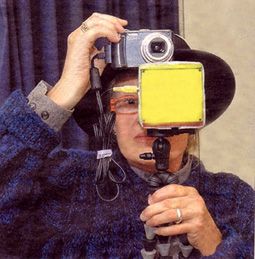 It
is not a matter of magnifying the images. It works because all the
details of the image is concentrated in a minute point of light. This
device is being tested out now in patients of the Ophthalmology Clinic
of Boston. Goldring uses it to make photos which lets her express
herself visually. The entire project is financed by NASA and MIT. It
is not a matter of magnifying the images. It works because all the
details of the image is concentrated in a minute point of light. This
device is being tested out now in patients of the Ophthalmology Clinic
of Boston. Goldring uses it to make photos which lets her express
herself visually. The entire project is financed by NASA and MIT.Tags:LED,Nasa,Ophthalmology |
Current Mood:  Accomplished
Accomplished

No comments:
Post a Comment