The
first time the word 'coffee' appeared in price boards of Barcelona was
in the year 1698. Considered to be a drug, it's also called 'el vino de
Los arabes' - 'Arab wine'. The first cafe or coffee bars that served
such black beverage were installed in Barcelona a whole century behind
the cities like Amsterdam, London, Venice, or Marseilles. Starting from
there the author Paco Villar has written a book without precedent: 'The
city of cafes, Barcelona 1750-1880, which is the story of the city told
through the vicissitudes of the first premises that served coffee, of
it's followers and adversaries, the municipal norms and the political
repression in 1831 driving the proprietors to exile.
After having written the best book available about the district of China Town, Paco Villar dedicated 12 years to investigate the origin and evolution of the cafes and the cafeterias of Barcelona, going deep into achieves, historical, municipal, newspaper, magazine and news journal libraries. This had helped to bring to light his first volume, which promises to be the longest, most encyclopedically complete account of all the cafes, bodegas (wine cellars and bars), restaurants and other leisure establishments of Barcelona. In this first volume, one discovers things so curious as to who was the first invented the menu of the day, which place was the first to install the billiard room, and why coffee was loved by some and condemned or attacked by others. How some have managed to become the most elegant and luxurious meeting points for the high society, and others for the literary or the celebrities. In fact, the author told the story of Barcelona through these colourful locations, considered to be the first dens of vice and sin, gambling, and later politico conspiracies of diverse ideologies. There were cafes where people played billiard, cards, and other prohibited games. In others there staged spectacles, from a single guitar to philharmonic concerts, to comedies and freak shows of people with deformities. Yet some others are as redoubts of patriots, liberals, or revolutionaries, even mutiny of frock coats! Places where concentrated manifestations of all kinds by labourers, burgesses, artists, writers, painters, journalists, even delinquents. Where business deals are made or dissolved, politics discussed, formed or reformed, crimes planned and committed ... On passing, it even told of how matches were invented and commercialised in a cafe bar, how some have transformed into inns with a restaurant attached, with a room or two for overnighters. And, which is the cafe reserved for women only, why the Duke of Victoria sent the coffee traders to exile, and Queen Elizabeth ll gave amnesty for them to return to the city. The 515 pages of the book is completed by recordings and photo albums, showing from the decoration to the many styles of menu cards, historic documents of opening licenses, sanctions, municipal norms, texts of detractors and supporters of the cafes. Once you have savoured the first volume, you would sure want to read the 2nd, centring on the 19th century, and the third, ending in the 20th century. Reading Villar's book is like taking coffee, a drink that incites you to take a second, and to a magnetic meeting point to unite with friends, telling each other a thousand and one stories. 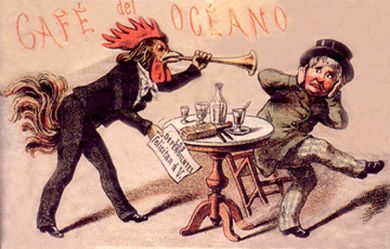 Christmas card from the employees of the Ocean Cafe to their Boss. Christmas card from the employees of the Ocean Cafe to their Boss. |
Current Mood:  Accomplished
Accomplished

No comments:
Post a Comment